
Brick Wall or Genealogical Challenge: Rethinking Your Approach to Genealogical Research
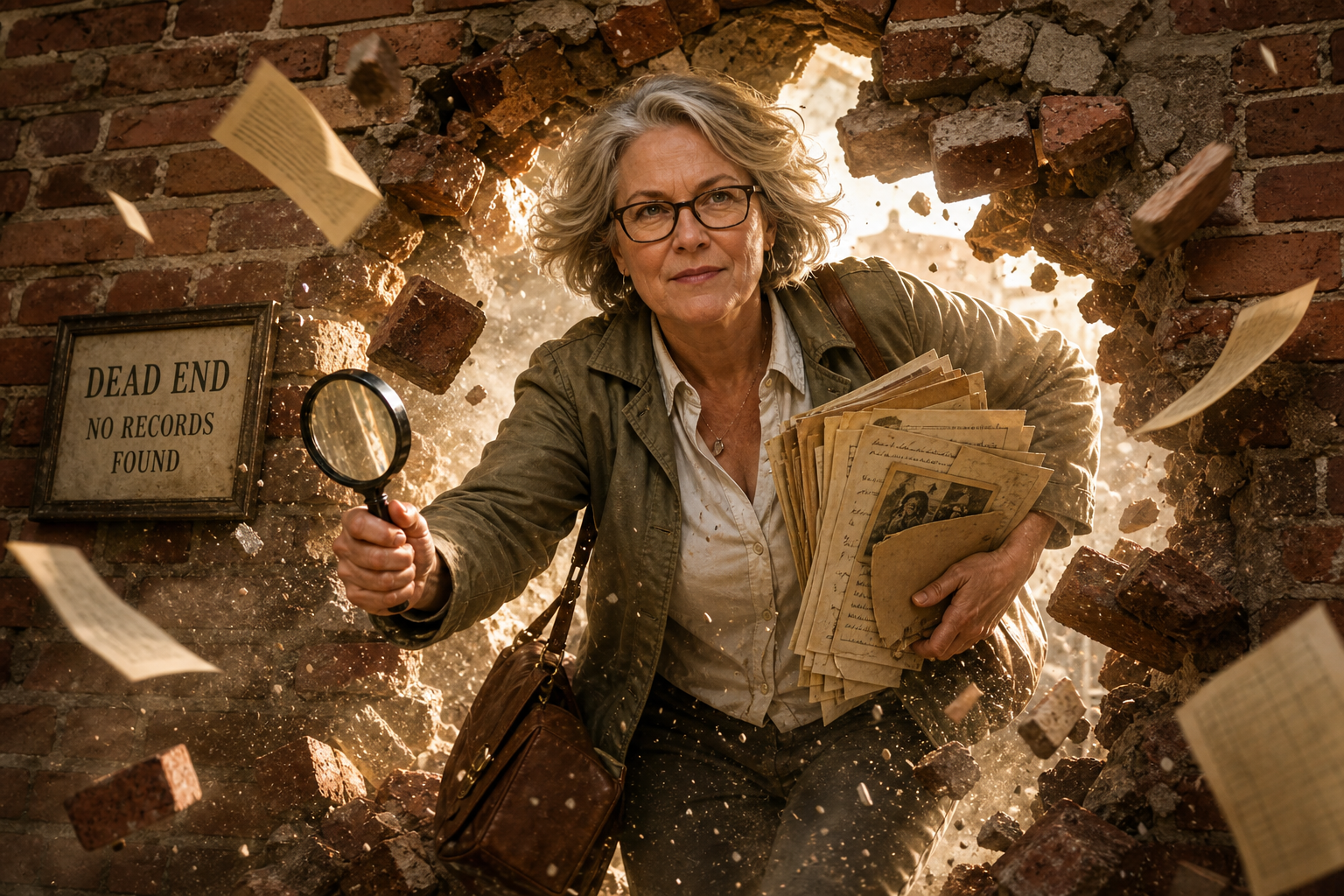
Cyndi Ingle of Cyndi’s List wrote a great article in the October-November-December 2013 issue of NGS Magazine about taking a new approach to genealogical research. She talked about what it takes to shake off old or non-productive ways of doing things and re-wire our brains in order to be more successful. Renowned genealogist Elizabeth Shown Mills talked about the importance of using evidence creatively in order to attain new ideas for working with records we already have. Over time, other genealogical writers have stressed the necessity of changing strategies when the old ways aren’t working. The idea behind all of them is to be open to new or alternate ways of finding and identifying ancestors.
It’s easy to think we’ve exhausted the resources, but it’s also possible that something else is out there that we didn’t know existed, especially today with new electronic/digitized resources, or that our search focus was too narrow, or that we’ve limited ourselves by basing our actions on assumptions without testing them. We may have looked nine ways to Sunday, but don’t rule out the possibility that there could be a tenth or eleventh or twelfth way. Our thoughts are a tool that can either help or hinder our research progress. The first step should be, as Cyndi Ingle said, to stop using the term “brick wall“. . . and change the vocabulary inside our heads.
A simple vocabulary change can have a positive effect on how we approach a problem, plan our strategy, and put that strategy to productive use in order to achieve our goals. One professional genealogist stated that her approach to research is that “there are no brick-walls in genealogy, only undiscovered sources and misunderstood information.”
Here’s another example of how changing the vocabulary can alter the thought process. Words have meaning; words can affect how we look at things. If we think about genealogical research as a challenge rather than as a brick wall, it can become an enticement rather than a discouragement. It also means that we’re being challenged to use our best genealogical skills. So not only can we work to increase the chances of solving the problem; we can also sharpen our skills and therefore become better genealogists. Think of it as a chance to bring out your best research skills.
A brick wall conjures up images of impenetrability and impossibility. It has the potential to make you want to give up. It is no less work to take on a challenge than it is to overcome a brick wall. But if you see a puzzle instead of a barrier in a “difficult” ancestor, you may be less likely to give up, and more likely to simply “take a break” to rethink your strategy or work on something else while your brain keeps working below the surface. Taking on a challenge instead of a brick wall means becoming creative. Not in the sense of manufacturing our own evidence, but in using evidence creatively to draw new ideas from “old” records. This is part of rethinking and re-wiring our brains in order to spot new clues in documents we already have.
“Creativity,” said Elizabeth Shown Mills, “means using ordinary records innovatively. It means devising new ways of looking at what is known to exist, new ways of linking evidence to form patterns and hypotheses, new ways of testing assumptions and conclusions.” In other words, “If you do what you always did, you will get what you always got.” If we want to increase our chances of finding answers, we have to change the way we look at things. Making assumptions without being willing to test and change them when it makes sense to do so means that we’re in a mindset that says ‘this is the only way to approach this problem.” What we want is to look for ways to widen paths instead of narrow them. We already have our challenge; don’t look for ways to place more obstacles in the path!
We know that success can’t be guaranteed. Just because we change our minds doesn’t mean that all of the answers will suddenly materialize. But we can work to increase the odds of being successful, and one way to do that is to change the way we perceive our research problems.
With all of this in mind, how can we put this changed vocabulary to work? We’ve started seeing challenges instead of brick walls. That is a shift in the right direction. Now we can take on difficult ancestors by looking at familiar genealogical methods in new ways. According to one professional genealogist, many problems can be solved by:
- “Observing how the sources were evaluated in the past.”
- “Opening up new avenues of research if the focus has been too narrow.”
- “Reexamining the chronology of events to make sure it is reasonable.”
- “Understanding the cultural and historical context of events.”
- “Studying kinship groups and collateral lines.”
- “Understanding migratory patterns.” Families tended to travel in groups, either together or by following one another soon after.
Evaluate the Source

Some researchers try only to locate the record and become disappointed because it doesn’t contain the information they expected to find. What is known about these sources? How reliable are they? Ask yourself:
- Is it likely to contain the information I need?
- Is it really what I need to solve the problem?
- Doing so can keep us from building our own barriers; we want to widen the path, not narrow it.
- Make expectations reasonable as far as what may be found in the record.
Widen Your Focus
- If you have been focusing on too narrow a scope, widen it by considering all pertinent record and people possibilities. Look at records generated by your ancestor’s family members from who you are NOT descended. We’ll talk about this “widening” concept in a bit.
- Look in not-so-obvious places. The United States Record Finder compiled by FamilySearch offers first, the best resources to check, and then the next-best resources, so that if you don’t find information where you expect to find it in resources in the first column, then you should check out the record types in the second column.
- For instance (depending on the time period and location), if you’re unable to locate a divorce in a court record, a notice might have been printed in the local newspaper. In this case, if we don’t at least check the newspaper, we have inadvertently placed an obstacle in the pathway of progress.
- Once in a great while, someone locates needed information in a highly unusual place. One researcher would never have known what her great-grandmother did during World War II if she hadn’t found her welder’s identification card from the Oregon Shipbuilding Corporation, or her dues slips for the International Brotherhood of Boiler Makers, Iron Ship Builders & Helpers of America. A conference speaker once told of finding names and birthdates of an ancestral family (Dad, Mom, kids), as well as the parents’ marriage date, carved into the underside of an 18th-c. wooden dining table.
Other Not-So-Obvious Places
- Bank records. Ancestry.com has an interesting collection of immigrant bank records. Sometimes immigrants would open an account at a bank specifically for the amount of money needed for relatives to immigrate to this country. These can serve as an alternate resource for finding immigration records. They also may provide clues to the name or address of other relatives.
- Fraternal organizations. Many immigrants belonged to fraternal organizations, and some of these provided things like insurance policies – which, if available, are an alternate source for death records. One researcher found my great-grandfather’s life insurance policy through the Polish Roman Catholic Union of America (PRCUA) on the Polish Genealogical Society of America website. Ancestry has a similar collection of enrollment and death benefit records for several state chapters of the Order of the Sons of Italy.
- Employment records. Private or federal. Sometimes these records can be found in special collections at libraries. If you’re not sure exactly where your ancestor worked, try getting a copy of their SS-5 application for Social Security, and for male ancestors try their draft registration cards at Ancestry.
- Funeral home records. Sometimes funeral home records can provide additional information about family members that aren’t found on a death certificate. Obviously the type of information that was requested – and kept on file – varies with the funeral home. Some are available online via Ancestry, but most probably reside with the funeral home itself if it’s still in existence. Some have been transcribed and printed.
- Passports. Ancestry Library Edition, accessible for free at Grapevine Library, has the database U.S., Passport Applications, 1795-1925.
- Coroner’s reports, police records, ethnic press newspapers, alien registration, off-year censuses. Each of these has the potential to provide some small nugget of useful information about your relatives. The key, of course, is actually finding out where these unusual resources exist.
Reexamining the Chronology
Reexamining the chronology of events is necessary to make sure it is reasonable. Check your people’s dates again and be sure they add up. If you show a mother giving birth at age nine or sixty-two, something needs to change. Knowing when county boundaries changed is crucial. You won’t find 1820 records in a county that wasn’t formed until 1821. Also, your ancestor may have had his address changed one, two, or three times without him moving an inch while new counties formed around him. Sadly, courthouse fires are legendary, especially in the South. Before you look for court records in a county, find out about possible record destruction, which sometimes happened more than once.
Timelines

When you feel “ancestrally challenged,” a timeline may be in order. Timelines can help in a variety of ways. They can show a chronology of ancestor’s life; show gaps between events; point out possible chronological inconsistencies that are keeping you from advancing; employ the FAN Principle by displaying Friends, Associates, and Neighbors who interacted with ancestor; follow migratory habits; link an ancestor to historical events; and show what you know and what you want/need to find out.
Kinship Groups and Collateral Lines
View your ancestors within the context of their families as well as of their times. Know who they are. In-laws and cousins, even siblings may hold the key to the answer you’re looking for. Maiden names of women can be found by obtaining a descendant’s brother’s or sister’s death certificate. Your ancestor’s brother’s widowed daughter-in-law may have the family bible. Don’t confine research to only direct lines. It’s like putting blinders on a horse; it can’t look to the side; all it can see is straight ahead.
Understanding Migratory Patterns

Families tended to travel in groups, either together or by following one another soon after, so your search should include neighbors as well as allied families. Also identify possible migration trails because some families may have stopped for a while before proceeding. If you’re lucky, surviving letters, diaries, etc. may mention other people traveling with the group.
Know the Law
You don’t have to be a legal scholar to know and understand the laws under which your ancestors lived, but you should learn about applicable local and state laws governing records AND ancestors because you may find those people in those statutes, especially those pertaining to divorce and other legal matters. Several books have been published containing genealogical information included in state statutes. Some statutes, like Virginia’s Hening’s Statutes at Large, are online and searchable.
In the next blog, we’ll look at additional new ways to look at old problems, plus some case studies of what can happen when we look “outside the box.”



Recent Comments