
How Did Your Ancestor Pay For That? A Brief History of Colonial Currency
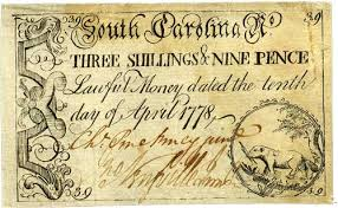
If you have colonial ancestors in your family tree, no doubt you’ve found records of purchases throughout their lives, whether it’s land, livestock, food, or various other items, as well as payments of taxes or services, and estimated property values in estate inventories. But what do those numbers mean, and what do they tell us where our ancestors were on the scale of wealth? Today’s blog will offer some explanations and resources to help you determine approximately how much colonial goods and services were worth, as well as approximate wage earnings of laborers and artisans.
How to Determine Value
First, we have to put ourselves within the frame of reference in existence at the time and place, because monetary values were relative to different colonies/states. We need some knowledge of currencies of the time and their equivalents in different colonies and states, and we have to understand that values were relative to different colonies/states. Payments were made with a variety of coins worth different amounts. So in colonial times, we have to “translate” those values into historical British equivalents of pounds (£), shillings (s), and pence (d). The “d” represents pence/penny (from Latin denarius); “s” represents shillings (from Latin solidus), and £ represents pounds (from Latin libra). Twelve pence (12d) = 1 shilling (1s); 20 shillings (20s) = 1 pound (£1).
Colonial and State Currencies
For several years after the Revolution and establishment of U.S. currency, people still used the British system in estate inventories. This was called “current money of state,” not British currency, because, as colonies, they of course used the familiar system. Each state issued its own currency which could vary with other states. We need to understand exchange rates to establish comparisons between colonies/states, and these rates fluctuated constantly.
Here we have a table (Fig. 1) showing the generally prevailing exchange rates by colony in 1774. This knowledge should prove helpful in determining approximate state worth. Fortunately, there are web site calculators that will do the work for you and we’ll get to those soon. This table shows the disparate exchange rates throughout the colonies and that worth was indeed relative.
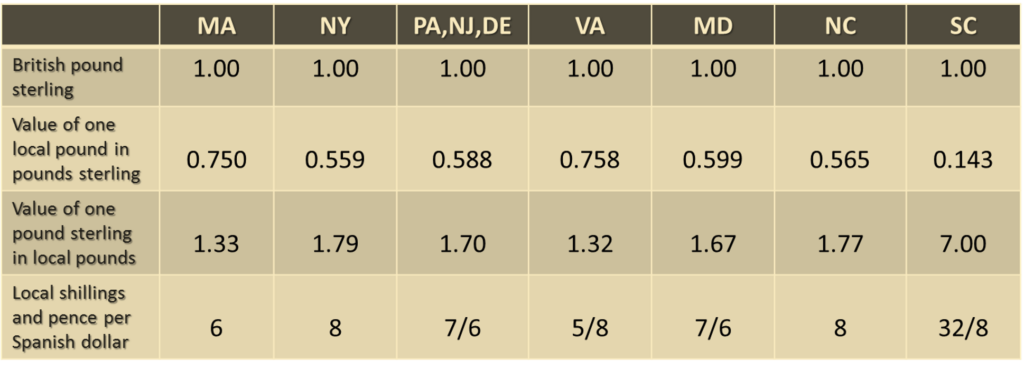
The rate shown in line 2 was used to convert local pounds to sterling. Rates on line 3 were used to convert sterling to local pounds. British colonists used pounds, shillings, and pence as their monetary units, and by 1774 each colony had its own local currency. Local prices were quoted in – and values stated in – probate inventories and estate accounts, and were in the local currency of the colony or province. Colonies’ relationships to each other and to pounds sterling varied from colony to colony and time to time so they can be compared only through the rates at which they exchanged for sterling or other money.
Exchange rates were not a uniform, definite matter. They were affected by the quantity of paper money issued by various colonial governments.
Britain forbade her colonies to mint coins, so settlers had to barter or use foreign coins, and local currency, Also, English coins remained scarce. The most circulated coin in the colonies was the Spanish milled dollar. It was so highly respected that it became an international trade coin. To promote uniformity in colonial money, Queen Anne’s 1704 proclamation stated that the Spanish dollar be made current in the colonies at six local shillings. Values of foreign coins were fixed at their intrinsic worth. However, just to make things interesting, some colonies ignored this proclamation and kept doing things their way.
The colonial exchange rate implied by the proclamation was 1.333 1/3 local units for one sterling unit, since 6 (local shillings) divided by 4.5 (the established exchange rate in England; 4 shillings and sixpence) equals 133.3. The point is to show that local prices quoted in, and the values stated in, probate inventories and estate accounts, were in the local currency of the colony or province. So the value of an item in an inventory could vary significantly between one colony and another. This means we have to look at each colony’s inventories individually. This is really seeing ancestral lives on a daily level – what they paid for what they owned and what its value was when they died.
Value of a Dollar
Congress authorized the U.S. dollar on 6 July 1785. As noted above, it wasn’t easy to determine the value of money in prior centuries, so below are some web sites that may help you do this. They give estimates at best, but they provide a general idea of a person’s relative worth.
Historical Calculators: Conversion and Worth
Eric W. Nye, “Pounds Sterling to Dollars: Historical Conversion of Currency”: http://www.uwyo.edu/numimage/currency.htm
Measuringworth.com: https://www.measuringworth.com/: This one calculates relative worth over time.
Historical U.S. Money: https://www.wolframalpha.com/examples/society-and-culture/money-and-finance/historical-us-money
Prices and Wages by Decade, 1770-2017: http://libraryguides.missouri.edu/pricesandwages/
Stay in Context with the Time Period
To understand relative worth during the colonial period, we must put ourselves in same frame of reference – the British pound – or convert that value into current dollars. Using consumer price indexes can help, but before 1800 there wasn’t much consumer price index data. However, Measuringworth.com has pre-1800 capability.
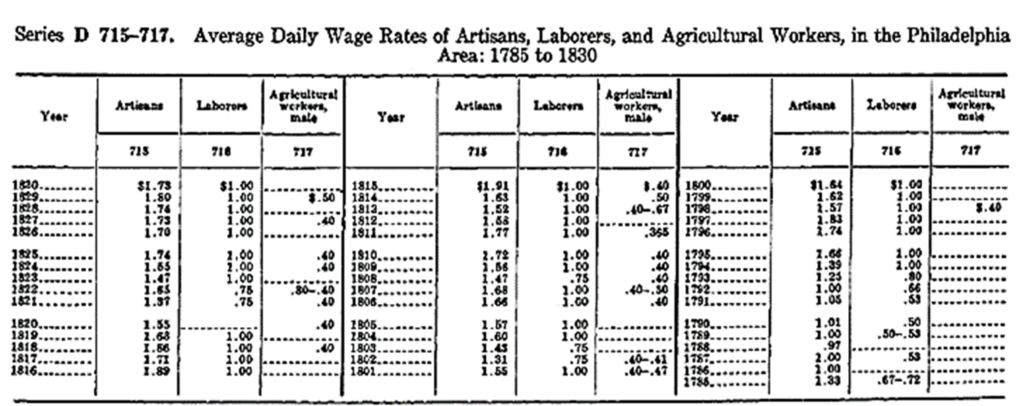
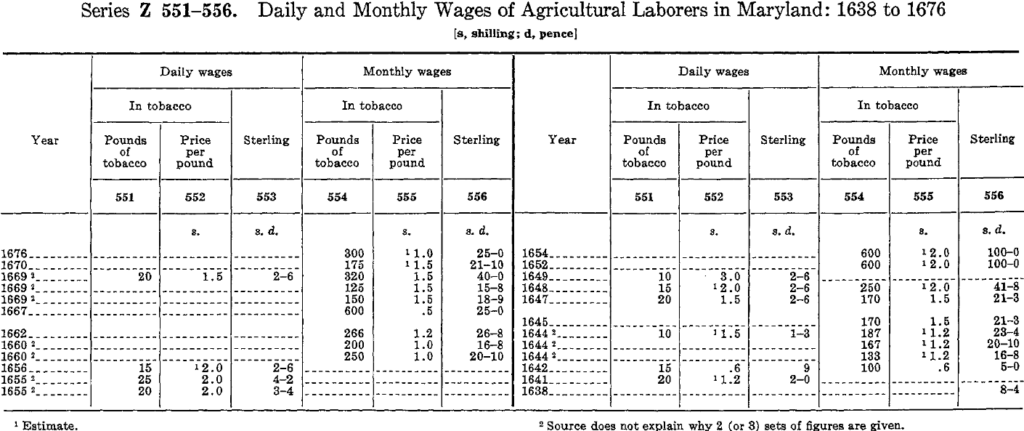
The best thing to do in terms of valuing an estate is to look at it in terms of the amount of labor required at the time to earn that amount of money. You’ll need to look at available wage charts for that time period and they’re not always easy to find. Measuringworth.com can help. Especially helpful is Historical Statistics of the United States, Colonial Times to 1970, Bicentennial ed., Part 2, Chapter Z, Colonial and Pre-Federal Statistics. It’s available and searchable at https://archive.org, https://hathitrust.org, and https://www2.census.gov/prod2/statcomp/documents/CT1970p2-13.pdf#[0,{%22name%22:%22FitH%22},807].
We can get a general idea of average daily wage rates by looking at examples from Philadelphia and Maryland from the Historical Statistics mentioned earlier:
It can be challenging to determine the value of American currency before it became standardized, but the available tools and resources can provide you with the information you need to approximate your colonial ancestor’s financial worth.



Recent Comments