
The Cotton Belt Railroad Comes to Grapevine
To most Americans in the late nineteenth century, the railroads looked like the key to prosperity and progress. Without the market access the railroads provided, there would have been little point in raising cotton in small-town Grapevine. Wagon freight rates averaged one dollar per 100 pounds per 100 miles. After 1879, rail freight rates were never more than one-half that expensive. Since Grapevine was not too far from major economic centers, it seemed destined to have a railroad. In 1888, the St. Louis, Arkansas, and Texas Railway (SLA&T) built its Cotton Belt line through Grapevine, thus allowing Grapevine to thrive as an agricultural trade center supplying goods to area farmers and serving as a shipping point for their produce.
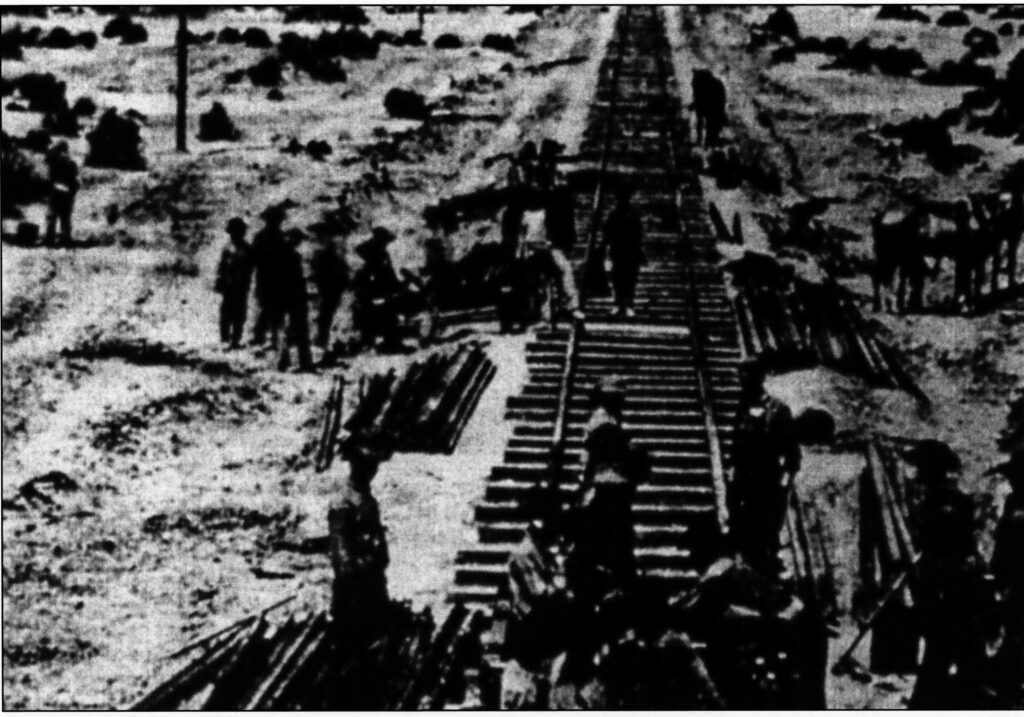
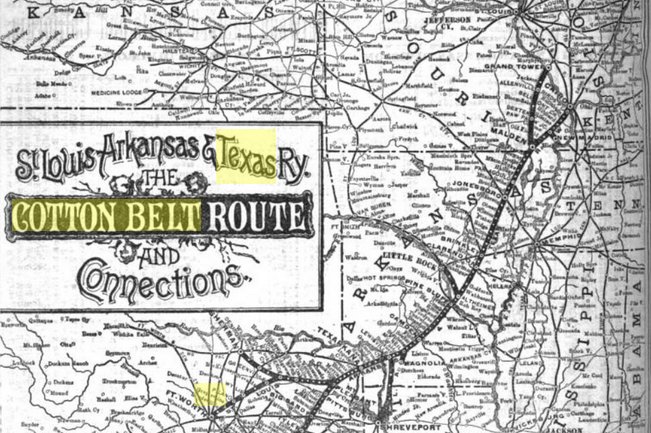
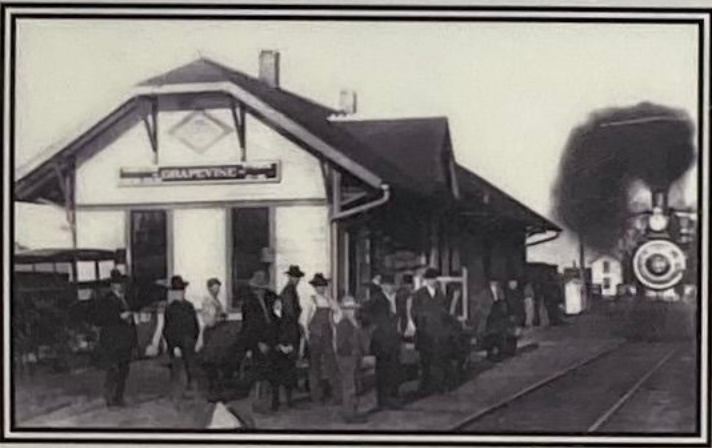
The SLA&T originated in Tyler, Texas in 1870. Influential Grapevine businessmen urged the railroad company to build what became known as the Cotton Belt Route through Grapevine in 1887, inaugurating service in 1888 (Fig. 1). This was an exciting moment in Grapevine history. Former Grapevine mayor B. R. Wall, then an eleven-year-old boy, recorded in his diary on March 22, 1888, that “ . . . the train is passing now. The Depot is nearly done. I will be glad when it is. The men that are working on it are going to dinner. They don’t camp out but they stay at the hotel.” In her 1935 college term paper, Grapevine resident Mary Ruth Starr wrote that “[i]n 1888 the whole town turned out to see the first train engine come into town. Many met it about a mile out of town and rode in. And for years every body [sic] dressed up on Sunday afternoon and went down to meet the train.”
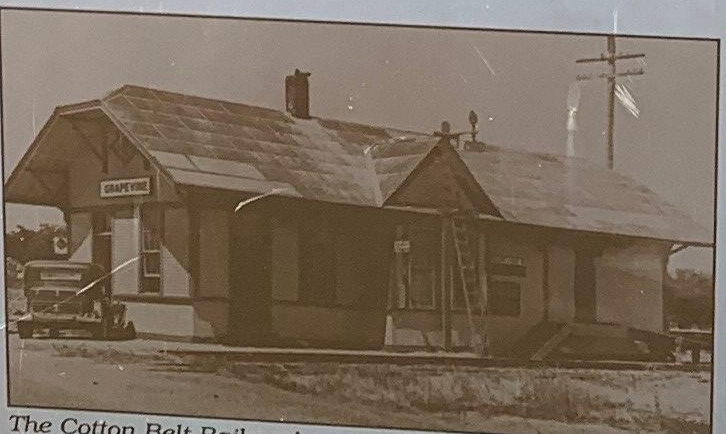
Renamed the St. Louis & Southwestern (SL&S) Railroad in 1891, the line connected Grapevine to Greenville and Texarkana to the northeast as well as Fort Worth to the southwest. The Section Foreman’s House and Depot were also in place (Fig. 2). The station supplied consumer goods, mostly cotton in the late nineteenth century, to township residents and farmers and solidified Grapevine’s position as a regional trade center. With the arrival of the railroad, the township became the shipping point for local crops and produce from hundreds of surrounding farms and a number of small rural communities. After the turn of the century, farmers shipped locally grown crops by rail to Dallas, Fort Worth, and other nearby markets (Fig. 3). Farmers would drive their hogs from farms along Denton Creek down Main Street to the pens at the railroad. In the fall, the roads leading to the gins would be white with cotton that had fallen off the wagons, and cotton bales would line the platform on the east end of the Depot.
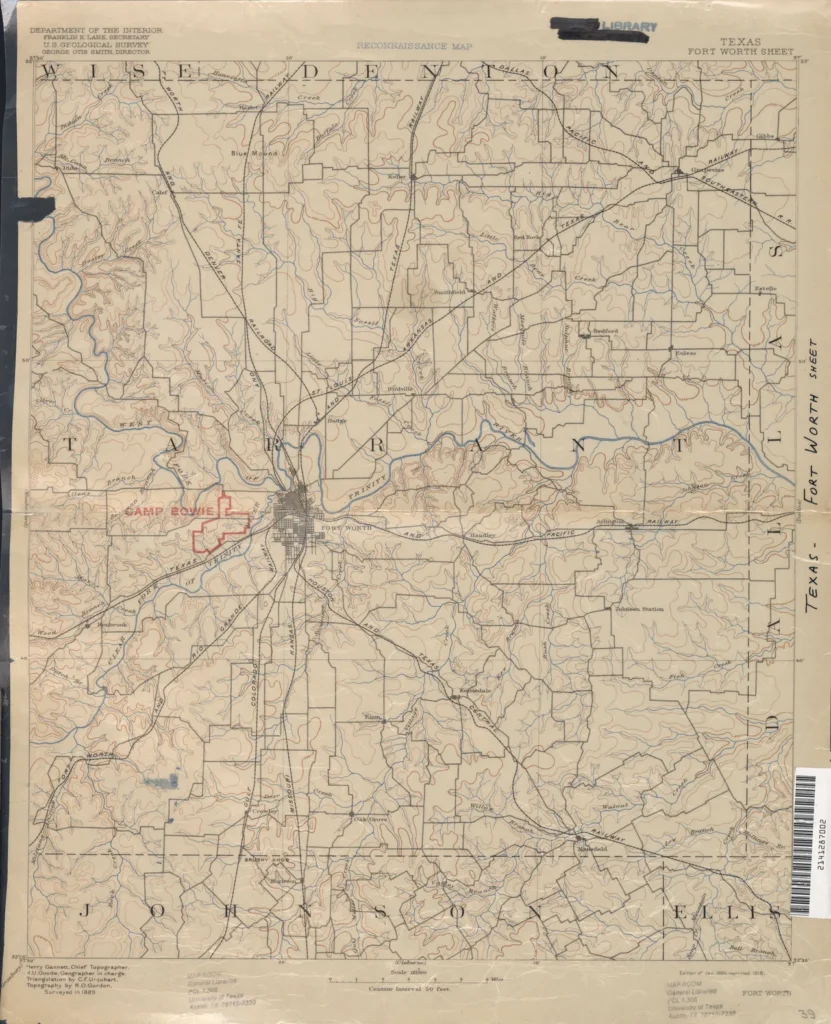
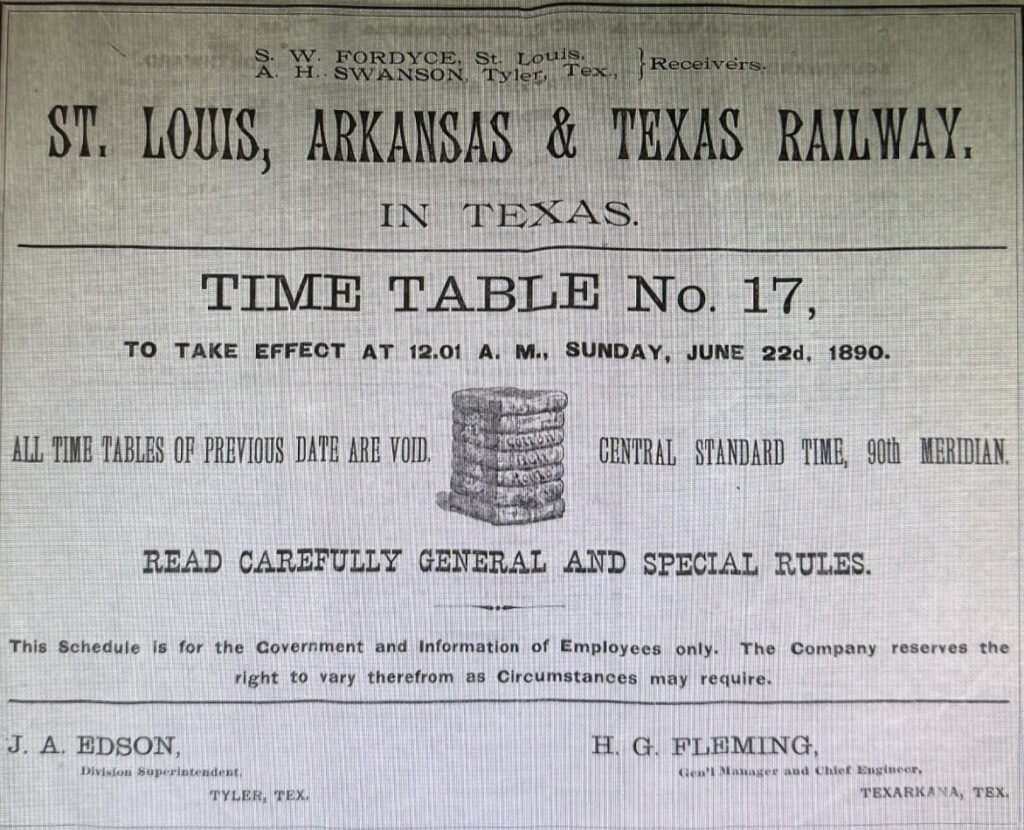
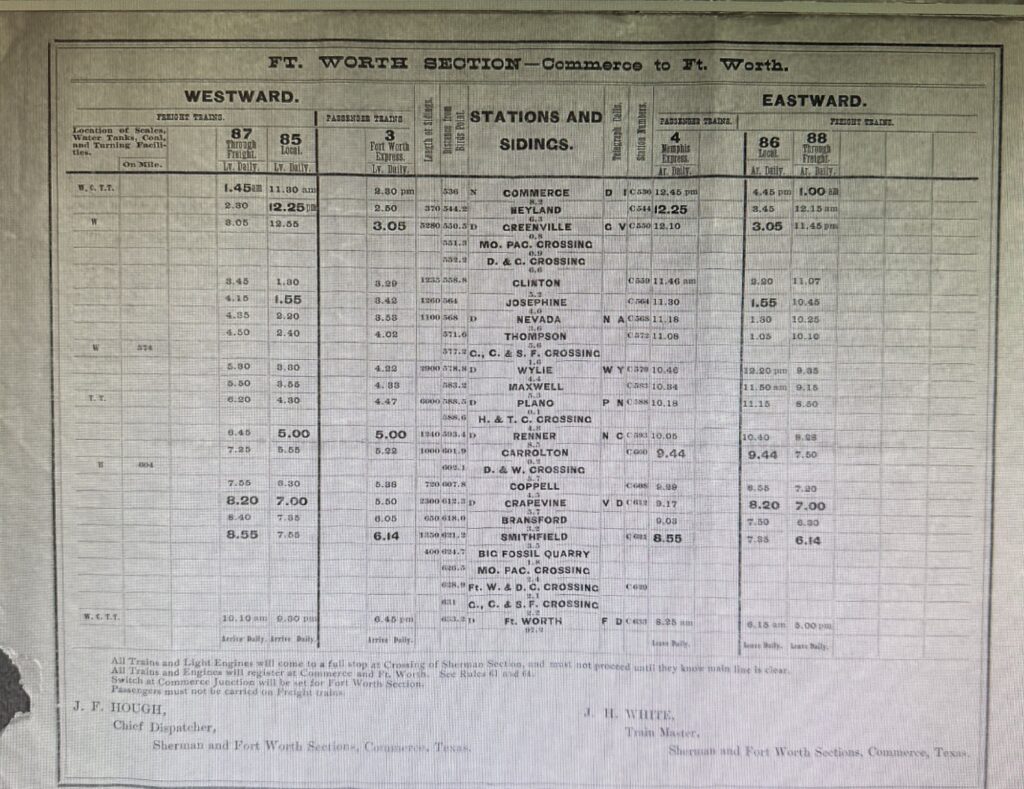
The Depot included segregated passenger waiting rooms, the telegrapher’s/station agent’s office, and a large freight storage room, and it was a hub of commercial activity. The earliest source document for an accurate record of train movements is the St. Louis, Arkansas, & Texas timetable No. 16, dated April 27, 1890, but No. 17, dated June 22, 1890, was the earliest located document (Figs. 4 and 5). The timetable shows directions as westward and eastward. In 1905, the direction changed to northward and southward. Passenger train No. 3 (westbound) was due in Grapevine at 5:21 p.m., and No. 4 was due at 9:03 p.m. The Grapevine Depot was built around 1901 and probably replaced an earlier, simpler structure that B. R. Wall described in his 1888 diary entry. The building would have served as a terminal for passenger and freight services. The station was originally located in the middle of Main Street, about thirty feet west of its present site, with the road curving around the building and then ending in farm fields 100 yards or so south.
The SL&S’s impact on the township of Grapevine and its development of a cash-crop economy was phenomenal. Although cotton had been cultivated in the area since the previous decade, production on surrounding farms increased significantly. Three gins were constructed on the west side of Main Street to process the crop for market. The North Texas Gin Company was built at the corner of College and Boynton Streets. The Farmers Gin Company sat at the intersection of Wall and Scribner Streets, and the Fort Worth Cotton Oil Mill Company opened in the 200 block of Church Street. By 1900, they were contributing to Tarrant County’s production of 11,580 bales. Grapevine speculators such as W. D. Tumipseed began purchasing other crops such as corn, wheat, oats, and cotton, in addition to buying and selling futures. A variety of small businesses sprang up to support companies and their employees that handled those commodities.
Farming implements and equipment were shipped in, and even building materials for the many new homes built near downtown in the early years of the century arrived at the Depot by flatcar. By June 1912 passenger train service had expanded to two passenger trains each way, daily. The two premium trains offered “standard sleeper” cars and chair cars. Two trains, one in each direction, ran in the morning, and two in the early evening. In March 1916, two more passenger trains, called “Lone Star,” were added through Grapevine, bringing the total to three each way, daily. The new trains did not stop. They ran on an accelerated, or expedited, schedule all the way between Fort Worth and Memphis. By September 1916, six passenger trains and twelve trains were operating. The Texas & Pacific station in Fort Worth served as the terminal for passenger trains, while freights used North Fort Worth.
Seeking to capitalize on profits from transporting commodities, including cotton, a group of Dallas businessmen chartered the Dallas, Pacific & Southeastern (DP&S) Railroad in 1889. Reflecting many speculative ventures in the railroad industry typical of the period, they intended to create yet another competitive east-west rail line linking Albuquerque, New Mexico, with New Orleans. Its route included stops at Grapevine and Dallas. Beginning in Dallas, the road was built westward for seventy miles, crossing the north side of the township and on through Tarrant County. However, construction ended abruptly when the company ran out of money. The roadbed lay abandoned for almost thirty years until it was finally used for the construction of Texas Highway No. 114.
By 1929, passenger service was reduced to two trains each way daily. “Lone Star” was renamed “Lone Star Limited” and no longer stopped in Grapevine. The second set of trains were gasoline-electric rail motor cars, pulling a trailing car. Passengers rode in the back portion of the motor car, and pouch mail, express, and baggage were in the trailing car. These cars acquired nicknames such as “Dinkey,” “Jitney,” or “Doodlebug,” depending on the locale. By the 1930s, however, automobiles and trucks were increasingly common, and ridership on the Cotton Belt to and from Grapevine declined. Passenger train service through Grapevine was reduced to a rail motor car, each way, daily, and was discontinued on June 14, 1936, so the only passenger service offered by the Cotton Belt in Grapevine was a mixed train, a freight train that provided room for passengers in the caboose. The Cotton Belt discontinued mixed-train service in the mid-1950s, and it ended passenger service in Texas on April 22, 1956. The Cotton Belt went bankrupt in 1935, but war-effort revenues allowed it to pay off its debts and discharge the trusteeship begun with Southern Pacific in 1932.
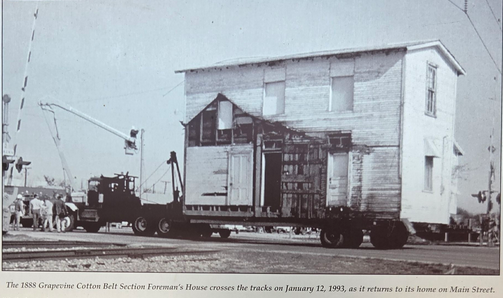
In 1937, the railroad decided to demolish part of the building, probably to save on maintenance costs. While a forty-two-foot section of the structure was removed from the center of the building, the remaining structure was also moved some fifty feet east to allow the town to straighten Main Street (Fig. 7). The “colored’ waiting room and half the freight room were removed during this renovation. Around 1961, the remaining waiting room on the west end of the Depot was also demolished, leaving only the office and a portion of the freight room.
On January 31, 1972, the Cotton Belt closed the Depot altogether, but thanks to the efforts of a number of citizens, including Mrs. Alberta Nettleton and the Grapevine Garden Club, the building was saved and given to the city. In 1973, it was moved to Heritage Park and became the newly formed Grapevine Historical Society’s Historical Museum.
The original railroad land became available for purchase in 1991, and the Grapevine Heritage Foundation acquired the 3.2-acre site to develop the Grapevine Heritage Center. The surviving Depot and the Cotton Belt Section Foreman’s House were found in two different locations in the community. The City acquired these sections and moved them back to their original location on the Cotton Belt Railroad near Main Street. The two sections were set in place, and a new center section was reconstructed and installed. The exterior and interior were restored to match the original design, including historic paint colors.
The restored depot is one building in a campus of structures that comprise Grapevine’s Heritage Park, which includes a farmer’s market, an arts and crafts compound, and the restored Cotton Belt Depot Railroad Section House. The Heritage Foundation raised funds through major grants from the Meadows Foundation, the Ann B. Lancaster Memorial Fund, Joe and Cecelia Box, numerous local civic organizations, corporations, and more than 160 individuals to restore the Depot to its original 1901 size and appearance. Exactly twenty-two years after the Cotton Belt Railroad closed it, the Depot reopened on January 31, 1994. The coaches are pulled by two of four vintage locomotives: an 1896 steam locomotive affectionately called “Puffy,” purchased in 1993; a 1953 GP-7 diesel locomotive affectionately called “Vinny,” purchased in 2003; or the twin 1957 FL9 EMD locomotives.
The Depot continues to serve new generations of Grapevine residents and visitors as a reminder of the community’s rich railroad history.


Recent Comments